

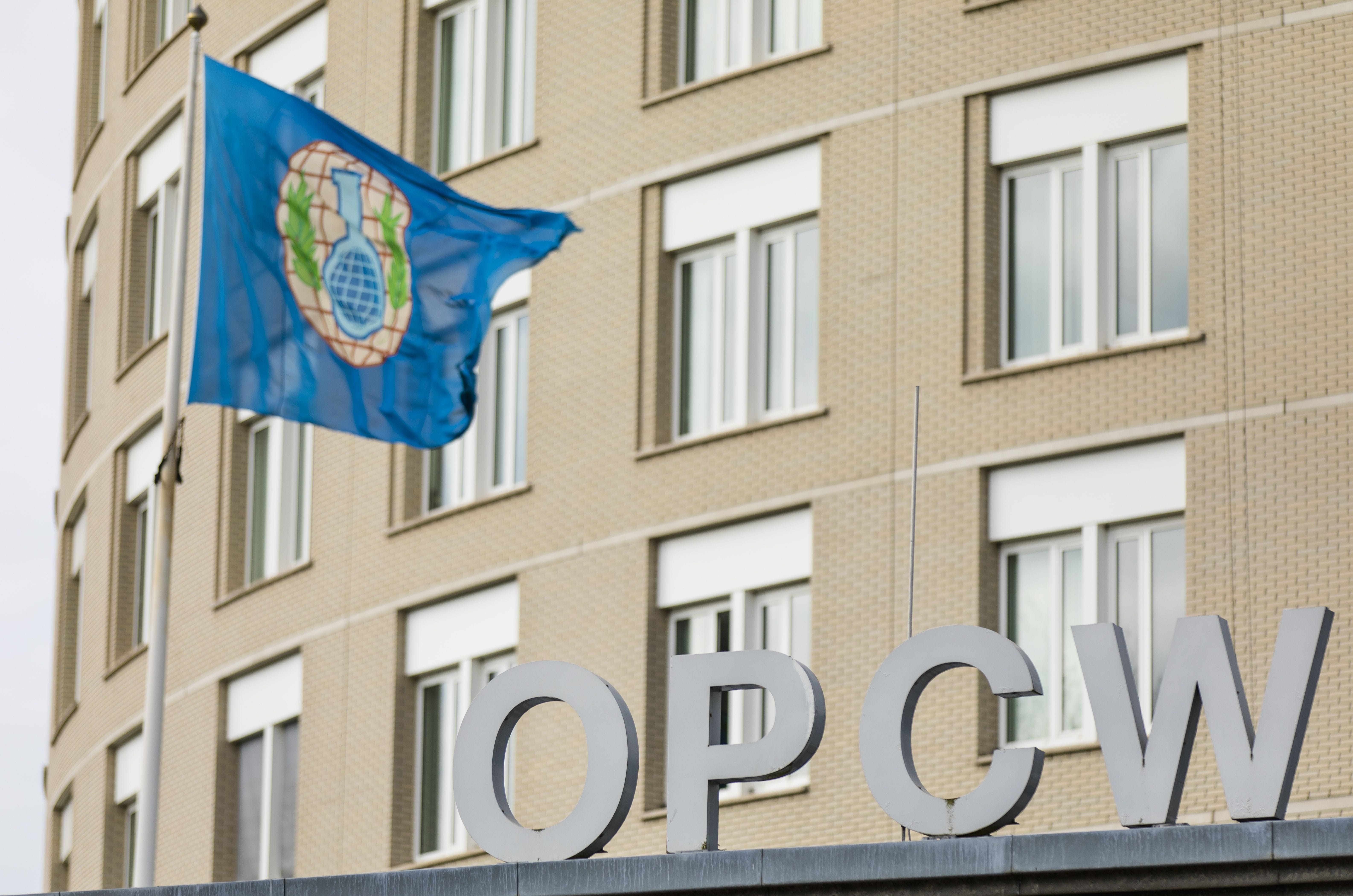
[Note: When veteran inspector Dr. Brendan Whelan challenged the manipulation of a probe into an alleged April 2018 chemical weapons attack in the Syrian city of Douma, the leadership of the Organization for the Prohibition of Chemical Weapons (OPCW) publicly disparaged and censured him. After a lengthy arbitration case, the OPCW has been ordered to reverse its decision and pay Dr. Whelan moral damages and legal costs. For the first time, Dr. Whelan tells the story of his years-long, Orwellian ordeal for justice. -Aaron Maté]
by Dr. Brendan Whelan
In Kafka’s distressing work of fiction, The Trial, Joseph K, a bank clerk with an unremarkable life finds himself accused by a faceless, totalitarian authority of a crime he did not commit; a crime that was not revealed to him. On the eve of his 31th birthday K was taken to a quarry and executed, ‘like a dog,’ still ignorant of the charges against him.
I have had my own Kafkaesque ‘trial’ moment, albeit, without the fiendish consequences that befell Kafka’s antihero. Mine wasn’t at the hands of some authoritative regime or even a corrupt local prosecutor. My accuser, sentencer and executioner was my employer, the Organisation for the Prohibition for Chemical Weapons (OPCW), a Nobel Peace Laureate and the world’s watchdog for the planet’s most deadly chemical warfare agents.
The Right to Know
My ordeal began in 2019 when an engineering study of two industrial chlorine gas cylinders, purportedly dropped from a helicopter in an alleged chemical weapons attack in Douma, Syria, in April 2018, was leaked from inside the OPCW. The unauthorized release contradicted the findings of the OPCW’s official Douma Report of March 2019, which concluded there were ‘reasonable grounds to believe’ a chemical attack had occurred. The report, according to the US Department of State, vindicated the reprisal missile attacks launched against Syria at the behest of US President Donald Trump before OPCW inspectors could enter Douma to investigate.
In response to the embarrassing leak, the OPCW Director-General instigated a major inquiry. Two OPCW inspectors involved in the Douma probe were in the crosshairs. I was one of them.
I was told by the OPCW that ‘Information ha[d] come to light indicating that [I] may have been involved in the breach,’ and despite having left the Organisation some eight months before the leak, that I was a suspect.
I asked, repeatedly, to be told the precise allegations against me; a right not only enshrined in law but in the Organisation’s protocols. They refused to elaborate or specify any charges. At that point I ended any collaboration with an investigation that was contemptuous of the requirements for due process. The investigation proceeded regardless.
The Show Trial
On 6 February 2020, the OPCW took the unprecedented step of publicly broadcasting its findings. Again, in breach of their obligations, they refused me a copy of the Full Investigation Report, which would, or should, have specified the allegations against me and the evidence to support them. Before a congregation of ambassadors and delegates from Member States of the Chemical Weapons Convention, the OPCW Director-General—in what the veteran British journalist, Peter Hitchens, described as a Show Trial– staged an overtly political and often defamatory briefing.
The official investigation report, for lack of evidence, had formally exonerated Inspectors A and B (as my colleague and I were referred to respectively) from leaking the sensitive document. Yet the Director-General was adamant that we were, nonetheless, not blameless. According to him, I had ‘deliberately and in premeditated’ fashion enabled the leak by failing to comply with the ‘specified procedures for the handling of confidential information so as to create a clear risk of unauthorised disclosure.’ This risk, he said, ‘materialised with the publication of [the] assessment on the [internet].’ Notably, he didn’t explain what the purported infraction was or how it could have led to the leaking of the engineering assessment.
A Deceptive Cover-story
By simultaneously clearing me for the leak while still impugning me over it, the Director-General laid bare his real motive.
It was no coincidence that I and my colleague—the only individuals investigated for the leak—had protested against bias and malpractice in the conduct of the OPCW’s Douma investigation, and, in my case, had been sidelined from the investigation for doing so. The OPCW had refused to address our concerns, which had since become a public controversy. The aim of the leak inquiry, therefore, was to attack our credibility without having to refute our scientific arguments.
‘Firstly, Inspectors A and B are not whistle-blowers,’ the OPCW Chief declared. ‘They are individuals who could not accept that their views were not backed by evidence. When their view could not gain traction, they took matters into their own hands and committed a breach of their obligations to the Organisation… As could be expected, their conclusions are erroneous, uninformed, and wrong.’
I, for my ‘wrongdoing,’ was issued with a letter of censure and a lifetime ban from future employment with the Organisation I had served diligently for seventeen years.
As the legacy media had been heavily invested in maintaining the Western line that Syrian forces had used chemical weapons in Douma, the OPCW’s ad hominem attacks on the two dissenting inspectors were treated as a vindication of the official narrative.
Reducing valid concerns about a cover-up scandal to a Russian disinformation campaign, the Guardian declared that: ‘Inquiry strikes blow to Russian denials of Syria chemical attack.’ Reuters spun their own fictional version of the findings, with a piece erroneously headlined ‘Chemical weapons agency employees leaked information, inquiry finds.’ Bellingcat, a NATO state-funded group that promoted its sponsors’ Douma allegations, declared that the investigation had laid to rest the OPCW cover-up scandal once and for all. ‘It is fitting that the last word on this subject should go to Mr Fernando Arias, the Director-General of the OPCW,’ Bellingcat wrote.
As it turned out, it wouldn’t.
Pushback
I wasn’t prepared to let this egregious attack on my person and my work go unopposed. I took the case to the Administrative Tribunal of the Geneva-based International Labour Organisation (ILOAT), the only legal recourse available to staff of global organisations. There, I challenged the OPCW to be specific about the charges against me and to present the evidence.
The OPCW did respond to the Tribunal. But it was a response that brought an unexpected and bizarre twist.
The Organisation casually abandoned the vague charges they’d made publicly and argued that I had not been sanctioned for anything related to the leaked engineering assessment. The narrative that I’d somehow enabled the leaking of the engineering assessment was now being swapped out for an entirely new account of how I’d supposedly breached my confidentiality obligations.
New Allegations
It was well known inside the Organisation that in June 2018 I’d sent the Chief of Cabinet an email to protest the suppression of the team’s Douma report and a secretive attempt to publish a doctored version. The Chief of Cabinet replied, denying any involvement and agreed to postpone publication. I forwarded his reply (containing my original protest email) to a senior Director with whom I’d expressed concerns the previous day about the conduct of the Douma investigation.
This was now my apparent crime. ‘The Appellant forwarded an email exchange between himself and the former Chief of Cabinet to Director-OSP which contained specific and detailed information about evidence gathered by the FFM [Fact-Finding mission] investigators in Douma,’ the OPCW told the Tribunal.
The ‘specific and detailed information’ they were referring to was a statement in my email to the Chief of Cabinet protesting the fact that the doctored report made the unsupported claim that ‘the team had sufficient evidence to determine that chlorine was released from two cylinders.’ This statement, despite being without basis, was ‘highly protected’, they said, and shouldn’t have been shared with the senior director. They said ‘The D-OSP was not part of the FFM investigation and therefore did not have a need- to-know.’
In other words, by informing the Director of Office of Special Projects of a phoney claim that had been fraudulently inserted into the team’s Douma report, I was committing a ‘serious breach of confidentiality.’ It is worth noting that, because it was challenged, this unfounded assertion was omitted from the final Douma report.
The fresh allegations didn’t end there. Sharing concerns directly with the Director-General was also criminalised. ‘On 25 March, the Appellant wrote a letter to the Director-General, challenging the findings in the Final Report on the Douma incident,’ the Tribunal was told. ‘[T]his letter, which the Appellant admits to sending, contained specific and detailed information gathered by FFM investigators from toxicology experts. In creating and disseminating this letter, he failed to comply with the specified procedures for the handling, protection, release, and dissemination of confidential information so as to create a clear risk of unauthorised disclosure.’
The confidential information I’d supposedly failed to adequately protect in this case referred to an official visit I and other OPCW experts made to Germany in June 2018 to seek the expert opinion of some of the world’s most renowned toxicologists regarding chemical warfare agents. These specialists had ruled out any possibility that the victims of the Douma incident were killed by chlorine gas, thereby lending significant weight to the prospect the attack might have been staged. This expert opinion was suppressed by the OPCW in its final Douma report, and had been a key concern I’d shared in my letter to the Director-General. Sending this letter to the head of the OPCW was a breach of my confidentiality obligations, they told the Tribunal.
What was also significant about this new allegation was that it was the first time management has officially acknowledged this meeting with the German toxicologists. Even mention of it was excluded from the inspection timelines in official reports. By extension, it was the first tacit admission that this crucial piece of evidence was censored from the Douma investigation.
The only rational explanation for all this bait-and-switch was that the OPCW couldn’t defend sanctioning me for supposedly enabling the engineering leak (because I didn’t). But rather than acknowledge the mistake, fresh spurious allegations were conjured up to broadly fit the fuzzy narrative of my guilt, and they proceeded as if these had always been the allegations.
Thought Crimes
If this about-turn in the allegations against me reeked of desperation, the newfound justification for the severity of the sanction meted out is disturbing.
My lifetime baring from future employment for forwarding an unclassified internal email thread to a senior Director was merited, they assured the Tribunal. ‘The effect of the breach of confidentiality was assessed as detrimental to the Organisation,’ because ‘[I’d] sowed discord within the Organisation.’ By sharing information “within the Secretariat [emphasis added] [I]caused a staff member to call into question the integrity of the Organisation’s findings in Douma.’
I had, it seems, gotten inside the mind of a senior OPCW Director. It could hardly get more Orwellian.
Vindication
Following a protracted legal process lasting six years, the Tribunal issued its ruling:
‘‘No disciplinary proceedings may be instituted against a staff member unless he or she had been notified of the allegations against him or her, as well as the right to seek assistance in his or her defence, as well as be given a reasonable opportunity to respond to those allegations. These steps were not taken [by] the Director-General [t]o the extent that the complainant was not provided with the charges [emphasis added] … The violation of the complainant’s due process in the disciplinary process was a manifest error.”
The Tribunal also faulted the OPCW for having “not provided [me] with a copy of the full investigation report.” Tellingly, despite claiming all the evidence for their new allegations was contained in this full investigation report, neither would they provide it to the Tribunal despite my challenge to them to do so.
After a lengthy struggle, I’d finally been vindicated. Personally, and professionally. The sanction had to be lifted. I could work again for the OPCW; an unlikely prospect, but at least possible. And they were ordered to pay substantial moral damages and legal costs. Now, they just need to take down from their website the offending report impugning me. And hopefully, Reuters, The Guardian, and others who parroted the OPCW’s falsehoods about a dissenting inspector will correct their errors.
Dr. Brendan Whelan, an organic chemist, served two stints at the Organisation for the Prohibition for Chemical Weapons (OPCW) over more than 16 years. In 2018, he went to Syria as part of the Advance Team to investigate the alleged chemical weapons attack in Douma. He was responsible for the scientific planning and coordination of the mission, and was the chief author of the team’s investigation report.
Thank you for sharing this information Aaron. As an 82 YO "news junkie" I haven't seen any mention of it in US or Canadian MSM. I believed the Inspectors back then thinking OPCW rejecting the report of it's Inspectors on the ground indicated Israel/US information manipulation.
So telling!
I hope that Dr. Whalen can find suitable employment in an organization whose integrity at least approaches that of himself. It is hard to imagine that will be possible, though, in any organization infected by the fatal toxicity of the Collective West.