

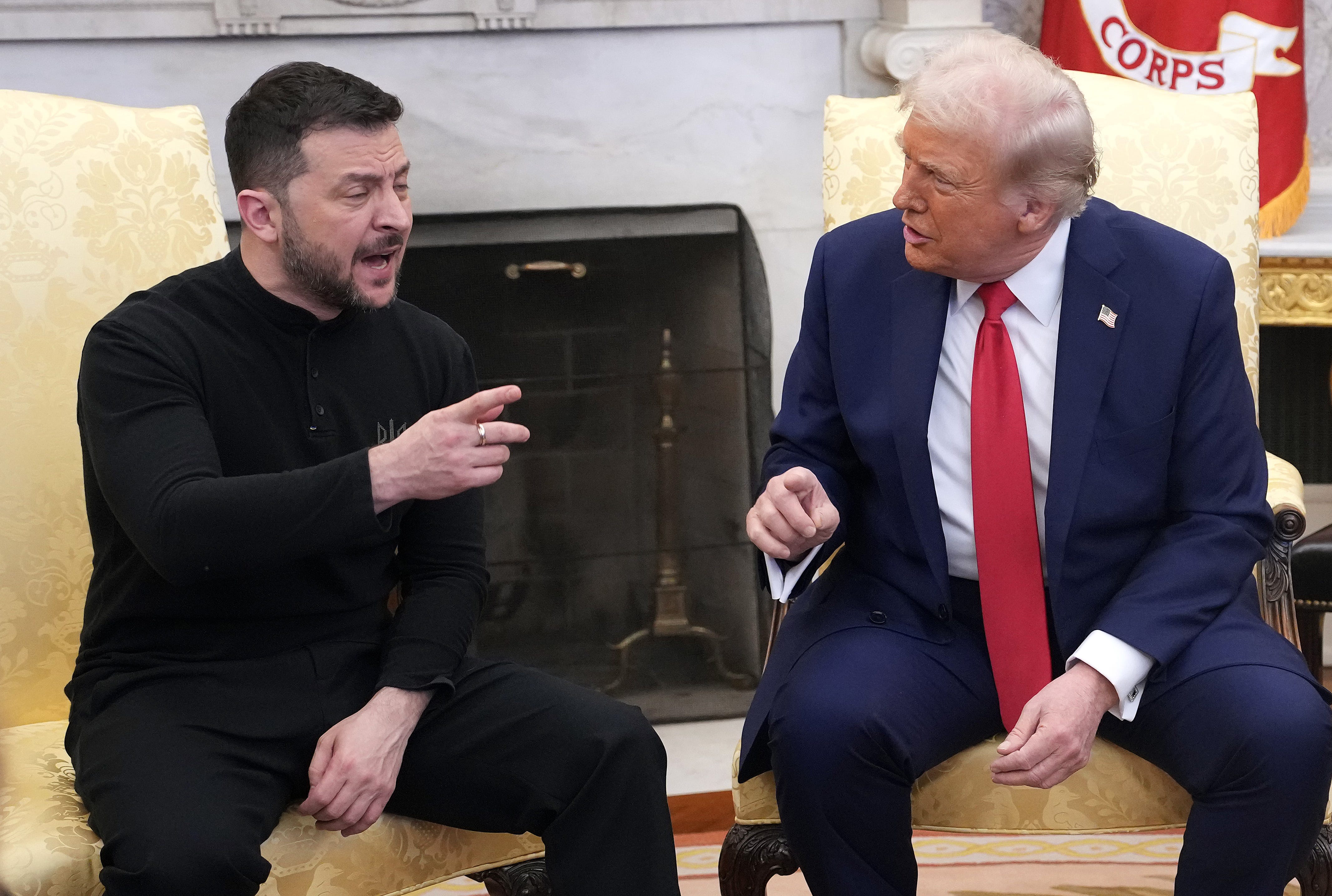
Seven years after Volodymyr Zelensky unwittingly helped House Democrats launch their first impeachment of Donald Trump, the president is exacting a far more punishing revenge. In recent weeks, Trump has eased curbs on Russian diesel exports, waived bipartisan sanctions against Moscow’s trading partners, delayed deliveries of Patriot missiles to Kyiv, throttled the US-provided Starlink service that helps Ukraine both launch and intercept drone attacks, and even called for his Ukrainian counterpart’s ouster. “Zelensky is a man that should’ve had this war settled a long time ago,” Trump has said in one of many derisive remarks. “...I think it’s time for somebody else to negotiate on behalf of Ukraine.”
Trump’s disdain for Zelensky and conciliatory gestures toward Russia are a product not only of a decade’s worth of Russiagate-fueled grievances but of his self-inflicted war troubles. His failed Iran regime change war has spiked global energy prices and forced him to ease tensions with Moscow in a midterm appeal to war-weary voters. Yet that does not mean his point is without merit. While NATO leaders and establishment media generally refuse to acknowledge it, it is now well-documented that Zelensky shunned opportunities that could have prevented, and later ended, the war. The most substantial thwarted tracks were the Minsk Accords prior to Russia’s February 2022 invasion and the Istanbul negotiations undermined by the US and UK weeks after it began.
A previously undisclosed off-ramp can now be added to this tragic list. According to an account in the Financial Times, Kyiv rejected a peace proposal that Vladimir Putin had signed off on right before the invasion’s one-year anniversary. The Biden administration, at best, looked the other way. In late October 2022, just as President Biden was musing about “Armageddon” to wealthy donors, a back channel opened between Putin’s circle and well-connected Ukrainians and Americans. The intermediaries were Matthias Warnig, a Russia-based former East German officer close to Putin; Alexander Rodnyansky, a Ukrainian film producer who was involved in the Istanbul talks; and two Americans, lawyer Richard Conn and investment banker Bob Foresman, who were in touch with Eric Green, the senior director for Russia on Biden’s National Security Council. According to Warnig, Putin relayed to the American intermediaries that same month that he is “very open to negotiations.”
The group drafted a peace settlement. Russian forces would withdraw from most of the four regions Putin had recently claimed to annex. Russia would only retain Crimea and the breakaway republics of the Donbas – almost a full restoration of the pre-invasion lines. Ukraine would recognize Russia’s control of Crimea and allow for a land corridor directly to the peninsula, but it would not have to recognize it as Russian territory. NATO countries would help guarantee the ceasefire, and Kremlin-White House negotiations would resolve outstanding security disputes.
On February 1st, Putin carefully reviewed the proposal and accepted it. He stressed his opposition to Ukraine joining NATO but supported its membership in the European Union. “If we can agree on the border and on NATO, then we can discuss everything else,” the Russian president said.
Zelensky did not reciprocate. Rodnyansky, the Ukrainian intermediary, “could barely get Zelensky and his powerful head of the president’s office Andriy Yermak to look at the documents on his phone.” The pair insisted that Kyiv “would make no concession to Putin on Ukraine’s borders” and they could resolve the conflict on the battlefield. When Rodnyansky observed that they “were acting as if Russia’s army would suddenly disintegrate... the Ukrainians laughed and agreed.” Notably, this account of Zelensky’s refusal comes not from the Russian side but from a Ukrainian interlocutor. It has also been corroborated by Ukrainian opposition lawmaker Oleksiy Goncharenko, who added further detail. Russia was reportedly prepared to give up the Zaporizhzhia nuclear power plant, and earmark its $300 billion in frozen assets toward the reconstruction of all of Ukraine, including the Donbas.
Rodnyansky also “felt the US needed to pressure Ukraine to accept a deal,” but Washington apparently wasn’t interested. National Security Advisor Jake Sullivan is said to have told Yuri Ushakov, Putin’s foreign policy advisor, that Washington had not approved the back channel. Former US officials dispute this account, claiming that Ushakov never raised the channel directly with Sullivan. Green, the former NSC member, denied receiving the proposal. “There’s a perception that we didn’t have any communications with the Russians, and that’s not the case,” he said. “So, if Putin really was interested in something like this, his people could have conveyed that to us in any number of ways.” Yet American officials have themselves acknowledged that Putin was sending out offers at this exact time. According to a previous account in The New York Times, Putin “sent out feelers for a cease-fire deal... in the fall of 2022.”
In the unlikely event that the Biden camp could make a plausible claim to ignorance, Zelensky certainly cannot. The Ukrainian leader even imposed sanctions on Warnig, the former East German officer, after his group’s peace effort collapsed.
According to the FT, the back channel’s members believe that “the US and Ukraine missed a potential opportunity to secure peace on far more favorable terms than Putin is now willing to entertain.” The reality is far more cynical. Not only did Zelensky miss another peace opportunity, but he concealed it from public view – all while his chief sponsor asserted that Russia had no interest in an off-ramp. On March 1st, 2023, less than a month after the back channel collapsed, Secretary of State Antony Blinken repeated his mantra that there was “zero evidence” that Putin was “genuinely prepared to engage in meaningful diplomacy necessary to end the aggression.” If he were, Blinken claimed, “of course we’d be the first to work on that and to engage.” Yet every time Putin did engage, including in Istanbul, the Biden team balked.
Zelensky remains just as intransigent. On Sunday, the Ukrainian president declared that “restrictions on our army and Ukraine’s neutrality are not up for discussion.” That is a full reversal from the early days of Russia’s invasion in March 2022, when he stressed that he was open to abandoning Ukraine’s NATO aspirations and discussing neutrality, which he acknowledged was why “they [Russia] started the war.” Ever since he catered to his sponsors and walked away from the Istanbul peace talks the following month, peace has not been up for discussion either. While Trump has run out of patience, the NATO political and media establishment continues to stand by its proxy war. What bodes well for Zelensky’s political survival bodes ill for a country trapped in a catastrophe he could have ended.
Great revealing of the truth.. Thanks Aaron.
All extremely sad, tragic, heartwrenching and worse, because there are no adequate words for what War does to human beings, the environment and the whole infrastructure needed to sustain life: food, fuel and Clinics Hospitals medical supplies, roads and bridges, trains, trucks you name it, let alone the mant tens of thousands of dead and injured soldiers and Civilians. Yes Zelensky needs to agree to real peace negotiations, if the right wing Fascists do not kill him first. Still - I point the finger if damnation primarily at the U.S. and the Brit Intel, along with all the weapons which were given to them.