

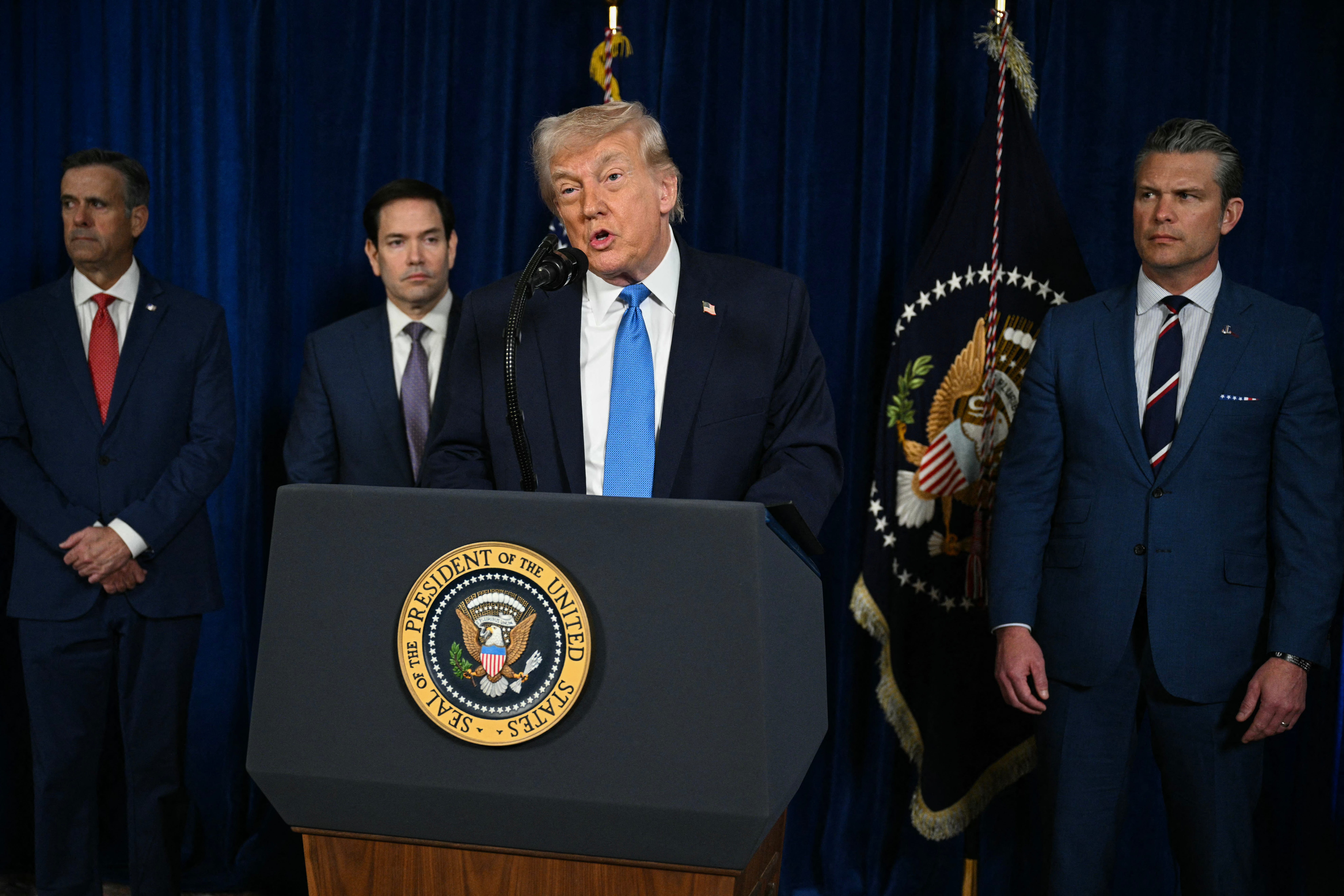
In announcing the US military’s attack on Venezuela and kidnapping of president Nicolás Maduro, an operation that reportedly killed at least 80 people, President Trump laid bare his real motive.
Invoking the 1823 Monroe Doctrine, which has underpinned decades of US aggression against Latin American governments, Trump bragged that “they now call it the Donroe Doctrine... American dominance in the Western Hemisphere won’t be questioned again.” The main target of that dominance is Venezuela’s oil reserves, the world’s largest. With US oil companies leading the way, Trump vowed, “we’re going to get back our oil... the money coming out of the ground is substantial.”
While Trump intends it as a riff on his first name, his signature doctrine is additionally fitting for mirroring the behavior of a Mafia Don: using violence, threats, and theft to obtain wealth.
In Venezuela, that has meant more than two decades of bipartisan US policy to destroy the country’s Bolivarian Revolution, which began under Maduro’s predecessor Hugo Chávez.
In April 2002, a rogue military faction kidnapped Chávez and installed Pedro Carmona, a business leader with close ties to the George W. Bush administration. (In a tactic that would be replicated in Ukraine’s 2014 Maidan coup, snipers fired on both pro and anti-government protesters to provide a pretext for Chávez’s ouster, an episode captured in the documentary “The Revolution Will Not Be Televised.”)
A de facto dictatorship was imposed under the Carmona Decree, which suspended the country’s democratically approved 1999 constitution and dissolved both the National Assembly and Supreme Court. Within 48 hours, a popular uprising of Chávez’s supporters, alongside a rescue operation by loyalist members of the Venezuelan military, returned the imprisoned leader to the presidential palace.
While the 2002 coup was quickly reversed, the foundation was laid for a long-term campaign of regime change. Among the signatories of the anti-democratic Carmona Decree was María Corina Machado, the Venezuelan opposition figure who, along with her allies, has received extensive US government support via regime change conduits the National Endowment for Democracy (NED), and US Agency for International Development (USAID). Machado, who has promised to hand over Venezuela’s valuable oil and mineral wealth for US exploitation and openly campaigned for US military intervention, was recently rewarded a Nobel Peace Prize.
The post-coup period coincided with a boom in oil prices, allowing Chávez to devote considerable resources to social welfare benefiting Venezuela’s poor majority. By all indicators, his program helped a marginalized population long excluded from Venezuelan politics. Under Chávez, unemployment was reduced by half, extreme poverty sharply reduced, and GDP more than doubled. These social gains, along with Venezuela’s open defiance of US hegemony and promotion of Global South cooperation, angered Washington, which has long targeted governments that defy its control. As a State Department cable advised in 1960 about Cuba, the US response would be to impose policies that “decrease monetary and real wages, to bring about hunger, desperation and overthrow of government.”
Chávez’s death in 2013 of cancer gave Washington and its opposition allies a new opening. Maduro, the chosen successor, lacked Chávez’s charisma and would quickly face a drop in the oil prices that had funded the Bolivarian program.
In March 2015, the Obama administration declared Venezuela to be an “extraordinary threat to the national security and foreign policy of the United States.” That move, Anya Parampil writes in her essential book “Corporate Coup,” hurt Venezuela’s economy by sending “international financial institutions a message to steer clear of Venezuela or risk facing Washington’s wrath.” Upon taking office, the Trump administration escalated that wrath with crippling sanctions targeting Venezuela’s oil sector, which accounted for 95% of the country’s export revenue. They also engineered the theft of valuable Venezuelan assets, including Citgo, the US subsidiary of its state oil company, and gold reserves held in UK banks.
According to Venezuelan economist Francisco Rodriguez, a harsh critic of Maduro, Trump’s sanctions “drove a collapse in oil revenues, contributing to the largest peacetime contraction in modern history.” The sanctions also fueled a wave of migrants fleeing their country’s dire conditions, as top Trump officials had anticipated. Thomas Shannon, who served as undersecretary for political affairs at the State Department, recalled warning that “the sanctions were going to grind the Venezuelan economy into dust and have huge human consequences, one of which would be out-migration.” But for Trump’s first term National Security Advisor John Bolton, a proud architect of the sanctions, economic collapse and migration were an intended result. “There was no doubt the sanctions, along with the general economic deterioration before we imposed them, was driving a lot of people out of the country,” Bolton said. “ … That, to me, was a way to put pressure on the country.”
Bolton’s admission underscores the cynicism of the Trump policy: knowingly crushing Venezuela’s economy, and then solely blaming Maduro for its collapse; and knowingly creating millions of economic migrants, and then demonizing them when running for office.
In his first term, Trump sought to replace Maduro with Venezuelan politician Juan Guaidó, who was recognized by the US as the legitimate president and feted with a bipartisan standing ovation in Congress. While Trump and his successor Joe Biden ultimately abandoned Guaidó, they did not give up on the overall goal. Since taking office last year, Trump has renewed his regime change campaign under the leadership of its biggest champion, Secretary of State Marco Rubio.
One year ago this month, Trump envoy Rick Grenell visited Caracas and successfully negotiated a deal to free American prisoners. Grenell’s back-channel diplomacy raised hopes of a broader rapprochement, but Rubio quickly put that to rest. “One of my priorities is to ensure that U.S. foreign policy sends a signal that it’s better to be a friend than an enemy,” Rubio explained. And Venezuela, Cuba, and Nicaragua – long targets of US regime change -- are “enemies of humanity.”
Under Rubio’s watch, the US escalated its baseless claim that Maduro was overseeing a drug cartel flooding the US with narcotics. Never mind that Maduro’s alleged cartel, the Cartel de los Soles, is not an actual organization, and to the extent that it has operated, only did so as a US partner. As CBS News reported in 1993, the CIA worked with a Venezuelan asset to ship cocaine into the US as part of an operation to infiltrate Colombian drug cartels. That effort was informally described as involving the “Cartel de los Soles,” a figure of speech referring to corrupted Venezuelan generals. It is for this reason that the Drug Enforcement Administration and State Department’s annual reports on the drug trade have never even mentioned the “Cartel de los Soles” by name. And while accusing Maduro of heading a fictional drug conspiracy, Trump recently pardoned the former Honduran President Juan Orlando Hernández, a convicted narcotrafficker who accepted more than $1 million in bribes to transmit drugs through Honduras and was caught on tape vowing to “stuff the drugs up the gringos’ noses.”
Trump and Rubio have made equally dubious claims about Maduro directing the gang Tren de Aragua (TDA), the pretext for deporting Venezuelan immigrants to a torture-ridden prison in El Salvador without due process. The Trump administration’s rationale was undermined earlier this year by a US intelligence report that concluded that the Venezuelan government “probably does not have a policy of cooperating with TDA and is not directing” its activities in the United States.
Unburdened by the facts and contemptuous of international law, the Trump team escalated this fall with a military buildup in the Caribbean and regular bombings of boats it claimed were shipping drugs. The US also opened a new campaign of piracy, seizing Venezuelan tankers to ensure that Venezuelans can’t even benefit from the oil that they manage to produce under crippling sanctions. Trump, the Wall Street Journal explained, “sees the more aggressive campaign as a foreign-policy win that could be an economic boon for the U.S. given Venezuela’s vast reserves of oil and other natural resources.”
Under these conditions of economic strangulation and military aggression, it is no surprise that Trump and Rubio finally got their man. The fact that Maduro was seized by US forces with little resistance indicates that Washington had cooperation inside the Venezuelan leader’s inner circle. As for the broader public, Venezuela is deeply divided, a split deliberately exacerbated by years of crippling sanctions.
What happens next in Venezuela, where Maduro’s remaining government is still in power under Vice President Delcy Rodríguez, remains to be seen. In his remarks, Trump threatened a second invasion, a clear threat to Maduro’s successors for complete submission.
The one certainty is that the Trump team’s aggression does not end in Caracas. In their public comments on Saturday, Trump and Rubio identified more potential targets. Colombian President Gustavo Petro, a critic of the campaign against Venezuela, “does have to watch his ass,” Trump declared. As for another critic, Mexican President Claudia Sheinbaum, arguably Latin America’s most popular leader, “something’s going to have to be done with Mexico,” he added. And Rubio, who has long sought regime change in his family’s country of origin, offered his own threat: “If I lived in Havana and I was in the government, I’d be concerned, at least a little bit.”
Under the Donroe doctrine, the warning applies to any vulnerable state that resists American dominance.