

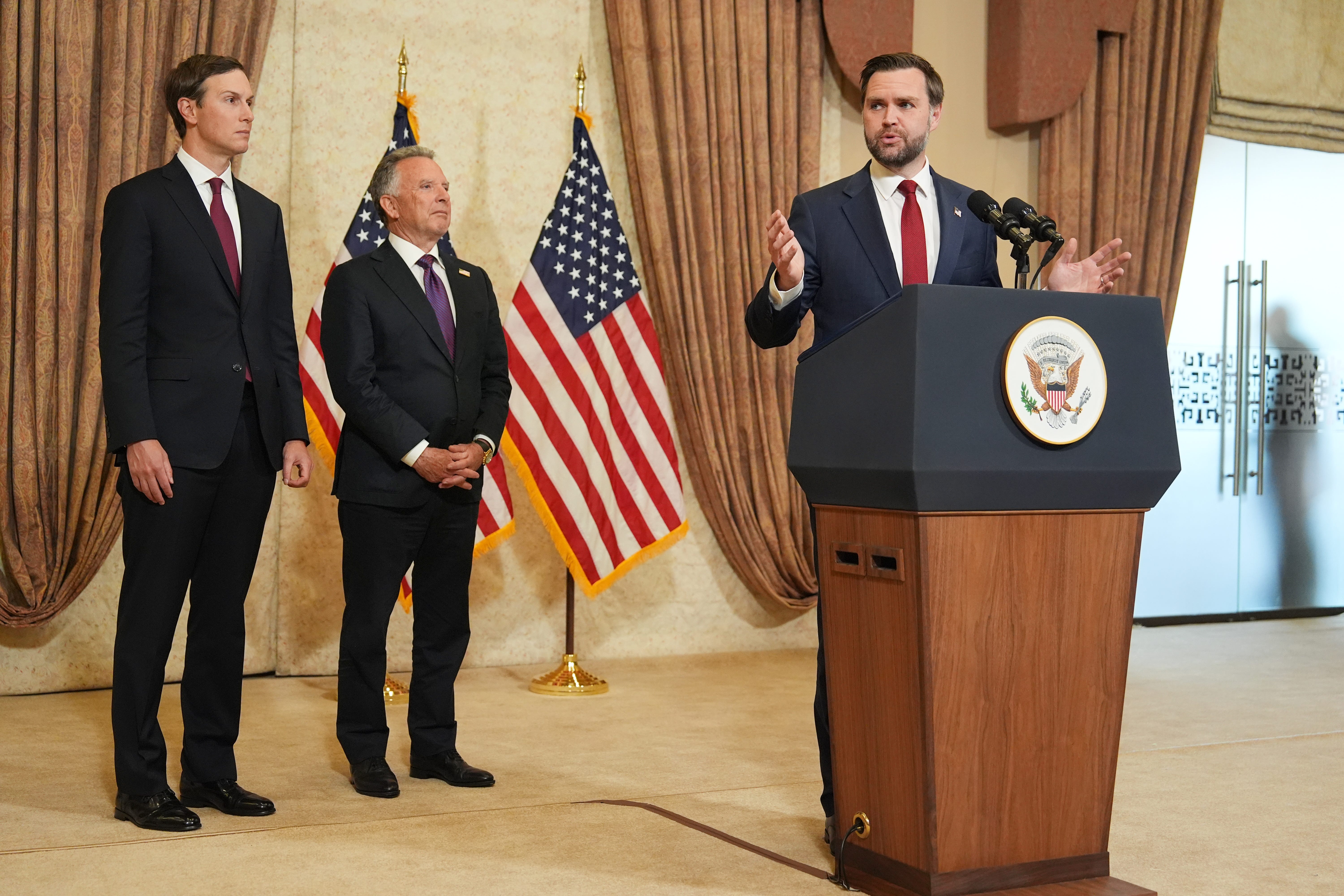
After returning from talks with Iranian counterparts in Islamabad, Vice President JD Vance said this week that the Trump administration is offering Tehran a “grand bargain”: “If you guys commit to not having a nuclear weapon, we are going to make Iran economically thrive.”
If this were actually Trump’s offer, there would be nothing left to discuss. In the 2015 JCPOA, and multiple occasions since, the Iranian government has reaffirmed that it will never “seek, develop or acquire any nuclear weapons.” Trump’s response was to shred the pact and impose “maximum pressure” sanctions designed to crush Iran’s economy. This economic warfare, continued by the Biden team in the interregnum, culminated in the current round of US-Israeli aggression that has killed thousands, left hundreds of billions of dollars in damages, pushed millions of Iranians into poverty, and also caused widespread carnage in Lebanon.
Vance gave a more honest summation of the US position a few days earlier when he ended the talks in Pakistan: “We just could not get to a situation where the Iranians were willing to accept our terms.” Indeed, the Iranians held the US to Trump’s stated position for accepting the ceasefire, when he called Iran’s 10-point plan “a workable basis on which to negotiate.” Instead, his designated envoy Vance – flanked by serial diplomacy saboteurs Jared Kushner and Steve Witkoff – simply reformulated the same terms for capitulation. Among them, that Iran abandons both peaceful nuclear enrichment and its support for regional groups that resist US-Israeli dominance.
For a Tehran government that has so far staved off, at great cost, a US-Israeli military campaign to impose those goals via regime change and Trump’s genocidal threats of ending Iranian civilization, these are non-starters. “The main problem here is that the Americans very mistakenly have been thinking that they have won the war,” a senior Iranian official told me. “So they are going to dictate their will at the negotiation table instead of a deal, which is normally based on a give and take.” If the US insists on extracting a surrender from Iran which “they couldn’t during the war, it is not going to happen.”
The Trump administration was forced to enter negotiations after Iran struck US military assets in the region and hindered the global economy by limiting naval passage in the Strait of Hormuz. According to Vance, Iran’s response amounts to “economic terrorism.” In reality, Iran is using its leverage over the Strait to end a campaign of US-Israeli terror, all while charging tolls to fund reconstruction.
Trump has responded with a naval blockade of his own, deploying US warships to intercept vessels that enter or exit Iranian ports. But Iran is not completely boxed in. It will try to evade the US siege through land-based shipping routes, all while Trump faces mounting global pressure over his disruption to global supply chains and energy markets. Iran has also threatened to counter Trump by expanding its blockade of the Strait to the Persian Gulf, the Sea of Oman, and the Red Sea.
Media accounts of the ongoing negotiations are focused on the issue of uranium enrichment, with both sides offering timelines for the duration of a potential curb on Iran’s nuclear program. Yet as Vance’s disingenuous “grand bargain” underscores, uranium enrichment is ultimately not the issue. At the last round of talks in Geneva, Iran addressed the White House’s professed concerns, ruling out any stockpiling of uranium and thereby closing off any potential path to a bomb.
Iranian flexibility was newly confirmed in the New York Times’ insider account of how Trump went to war. After meeting their Iranian counterparts in Geneva, Kushner and Witkoff reported to the president that they “could probably negotiate something, but it would take months,” and maybe even “a lot” of effort. A months-long timeline would be a lost faster than the JCPOA, which took nearly two years to finalize before Trump tore it up. Because Trump, yet again, had no patience for diplomacy, he launched a war of aggression instead.
The chief obstacle to a grand bargain is Washington’s unfettered support to the main source of all instability in West Asia: Israeli aggression. Just as the ceasefire came into effect last week, Israel launched a new wave of violence in Lebanon that has killed hundreds of civilians, destroyed thousands of homes, and forced over 1.2 million to flee. Israel was aiming to provoke a response from Iran in defense of its ally Hezbollah, thereby undermining the ceasefire and cajoling Trump to resume the regime change war that Benjamin Netanyahu lobbied him to undertake. Iran instead insisted on respecting Lebanon’s inclusion in the ceasefire, which has helped compel Trump to announce a 10-day ceasefire in Lebanon earlier today.
Trump says he plans to host additional talks between the Israeli and Lebanese governments. The US will try to compel the pliant Lebanese president Joseph Aoun to reject any linkage with Iran, which could free up Israel to continue terrorizing the Lebanese people and trying to wipe out Hezbollah. While there is indeed a major split inside Lebanon over Hezbollah’s militant activities, a vast majority opposes any normalization with Israel, whose leadership openly fantasizes about expanding “Greater Israel” up to the Litani River. Hezbollah is the only force inside Lebanon that can repel Israel’s colonial designs.
Because the Trump administration won’t constrain Israeli expansionism, it won’t acknowledge that the Iranians have long offered a grand bargain to resolve all of these flashpoints. As far back as 2003, the Iranian government floated a sweeping agreement with the US to limit its nuclear program, cooperate against “terrorism”, end “material support” to Palestinian militant groups, and help convert Hezbollah into a strictly “political organization” inside Lebanon. In exchange, Iran wanted respect for its sovereignty, an end to all sanctions, and US-Israeli acceptance of the Saudi peace initiative, which would grant Palestinians a state within the 1967 borders.
According to then-senior State Department official and longtime Council on Foreign Relations president Richard Haass, the Bush administration shunned the Iranian proposal because “the bias was toward a policy of regime change.” Subsequent administrations have ignored similar overtures. This includes a December 2017 declaration from the Organization of Islamic Cooperation, endorsed by Iran and Hamas, calling for a “two-state solution with East Jerusalem as the capital of the State of Palestine” alongside a just resolution for Palestinian refugees.
Rather than accept the latter, which happens to reflect the consensus of virtually every other state on earth, US-Israeli leaders maintain a status quo of occupation, ethnic cleansing, land theft, and regime change. Because Iran anchors a regional grouping that resists this agenda, the grand bargain that it offered the US more than two decades ago remains a non-starter in Washington. Under this posture, Trump will be limited to walking away and leaving Iranians to rebuild, under crippling sanctions, from the latest wreckage that the president and his Israeli partner have gleefully caused.
I look forward to your updates in my e-mail; on the Judge, and wherever I can find you. Your updates are comprehensive and honest. Thank you for the work you do in keeping us informed. P.S. don't stop working on your book; can't wait for its publication. :}
All our middle eastern wars were fought for Israel, all those Americans who died in those wars died for Israel. They have used the US long enough!!!!! Iran was always on Netanyahu's hit list, as were all the other countries destroyed in our Middle Eastern wars. The only one that I've seen who has given full recognition of this fact is Jeffery Sachs, who really spelled it out in his interview with Tucker Carlson. Israel wants to become number 1 in the region or as they say an imperial power which means it needs it's part of the world divided into smaller regional powers, like what's going on in Lebanon at the moment. Israel who implemented a genocide, and I'm sure is not finished has brought a sense of barbarism into the US and the world. I'm sick of them and US! If things were put into a broader context instead of referencing a particular war, people would have a broader, more realistic perspective and maybe that could end it all!