

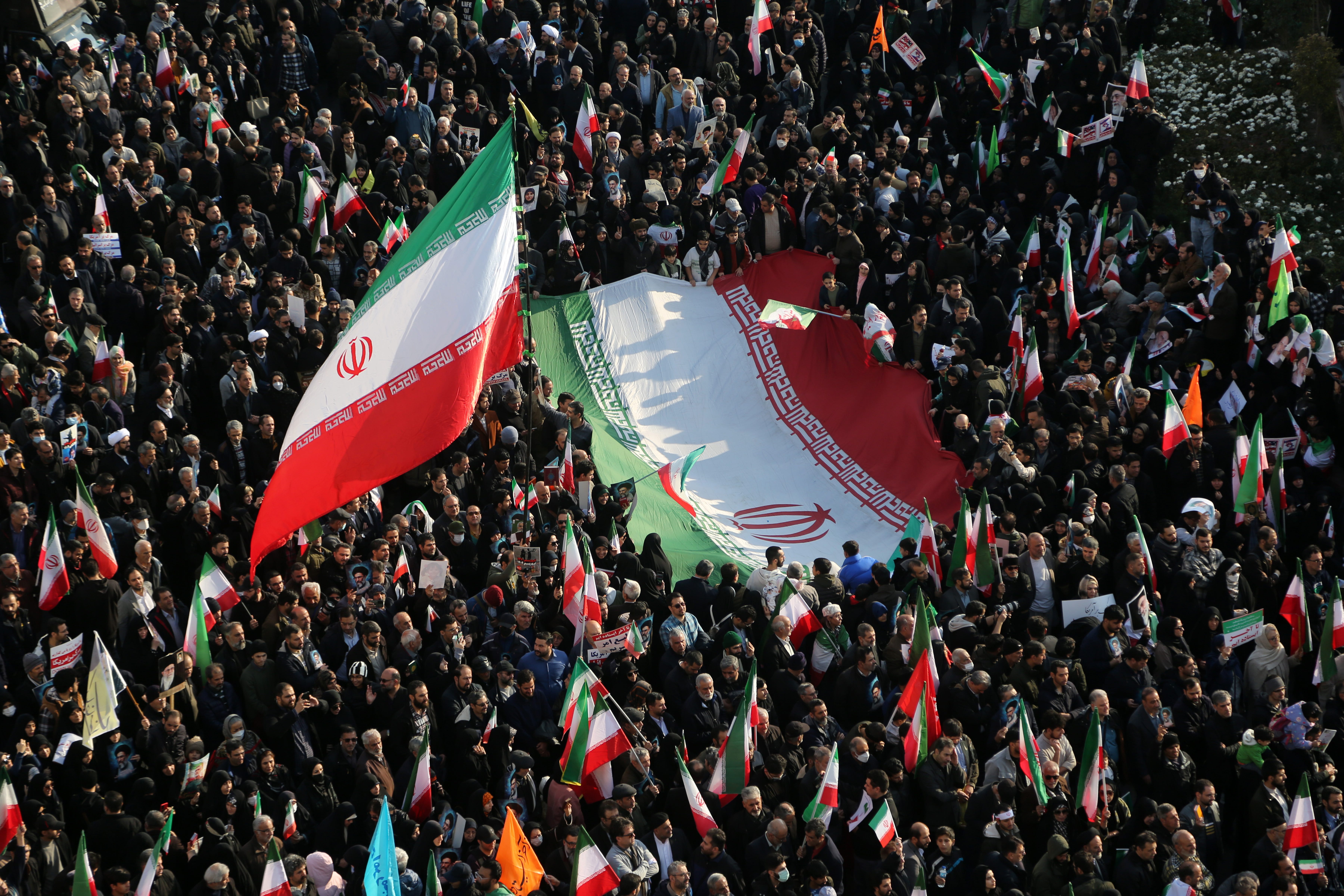
After campaigning as a foe of US military interventions and regime change, particularly in the Middle East, President Trump has threatened to bomb Iran for the second time in less than one year. In public comments, President Trump encouraged Iranian protesters to take over government buildings and assured them that “help is on its way” in the form of “strong action.”
Whatever Trump decides—and whatever one thinks of the Iranian government—one certainty remains: he will not offer Iranians the most tangible help he could by ending crippling US sanctions.
In fact, Trump pledged to expand the economic pain worldwide by declaring a new 25% tariff on Iran’s trading partners, including China. If he follows through, this would raise costs for everyone, including US consumers.
The spark for the recent protests, which began peacefully in Tehran’s Grand Bazaar, was the severe depreciation of the Iranian rial, which fell 84 percent in 2025 to a record low last month. The protesters have demanded that the government address rampant mismanagement and graft. Yet even if Iran could root out all corruption, the country would remain in a perilous state. As the Wall Street Journal noted in 2022, US sanctions against Iran’s oil industry and financial system “are the main factor crippling the Iranian economy.”
After Trump withdrew from the Iran nuclear deal and reimposed “maximum pressure” sanctions in August 2018, the rial saw an immediate, drastic decline. A recent study found that, because of Trump’s sanctions, Iran’s middle class was now 28% smaller than it would be under normal conditions, as compared to similar economies. By shrinking Iran’s middle class and pushing more people into extreme poverty, Trump has weakened the very people who have typically driven Iranian social movements. And by altering “the social class structure of the country,” Iranian economist Hadi Kahalzadeh observes, Trump’s sanctions “stigmatize the idea of engagement with the West as a solution to Iran’s economic woes.”
The Western architects of US sanctions intended this deprivation. Richard Nephew, who oversaw the State Department’s sanctions policy during the Obama administration, described the contraction of Iran’s economy as “a tremendous success.” As one example, Nephew wrote, US-led sanctions “directly contributed to the depreciation of the Iranian rial and, consequently, played some part” in making medicines unaffordable “because they cost too much for the average Iranian.”
In 2019, Secretary of State Mike Pompeo acknowledged that US sanctions were designed to both hurt the average Iranian and undermine diplomacy with their government. Asked by CBS News if his financial coercion was “pushing Iran to negotiate” with Washington, Pompeo replied that negotiations weren’t the point. Instead, he explained, “things are much worse for the Iranian people, and we’re convinced that will lead the Iranian people to rise up and change the behavior of the regime,” which creates “havoc throughout the Middle East and, frankly, throughout the world.”
Pompeo — and virtually all establishment media — omit that Iran’s “havoc” is a response to decades of US-led aggression, starting with the 1953 CIA ouster of Prime Minister Mohammad Mosaddeq. In 2010, the head of the Defense Intelligence Agency, Gen. Ronald Burgess noted that “Iran’s military strategy is designed to defend against external threats, particularly from the United States and Israel.” Four years later, the Pentagon again concluded that “Iran’s military doctrine is defensive... designed to deter an attack... and force a diplomatic solution to hostilities.”
As Pentagon analysts forecast, Iran has used violence to attempt to restore the diplomacy that Pompeo and his colleagues sabotaged. In 2021, for example, a wave of drone attacks by Iranian-allied Iraqi militias on bases hosting the CIA and US Special Forces was an attempt to “step up pressure on the United States... to negotiate an easing of [US-led] sanctions as part of a revival of the 2015 nuclear deal,” and had been “designed... to minimize casualties,” the New York Times reported. Indeed, in the last two Iranian retaliations to US attacks – the assassination of Qasem Soleimani in 2020 and the bombing of Iranian nuclear sites in June – Tehran telegraphed its strikes to ensure that it hit empty US bases in Iraq and Qatar.
Unlike the US and Israel, Iran has also accepted the global consensus on how to resolve the core issue at the heart of all Middle East conflict: Israel’s denial of Palestinian self-determination. In 2017, the same year that Hamas formally revised its charter along similar lines, Iran endorsed a peace offer from the Arab League to Israel based on a “two-state solution with east Jerusalem as the capital of the State of Palestine.” The longstanding Israeli position, backed by the US, is to refuse to even discuss this overture, which for Palestinians entails a historic compromise.
Whereas Iran has used violence to compel diplomacy, the US and Israel have used violence to undermine both diplomacy and Iranian self-defense. After bombing in June on the pretext that Tehran was close to a nuclear weapon, Israeli and US officials admitted that this was a ruse. According to an account in the Washington Post, senior Israeli officials had “already decided by March” to attack Iran -- the same month that US intelligence chief Tulsi Gabbard affirmed “that Iran is not building a nuclear weapon.” Israel’s preference for aggression was based on the awareness “that Iran would have rebuilt its air defenses by the latter half of the year”, which gave Israel “a unique opportunity to execute plans, carefully laid months and years in advance, to heavily damage a weakened Iran.”
If Trump exploits Iran’s current unrest to carry out another bombing, he would be pursuing the same goal. As Pompeo declared on Fox News last month, “we can’t let them rebuild their air defenses... so time will be critical in making sure the air defense systems in Iran aren’t capable of taking down Western aircraft.” In US-Israeli eyes, Iran is not only barred from building a nuclear weapon, but defending its own airspace.
In the push for a new military escalation, the admissions have become even more brazen and cynical. As the Iran protests erupted over the New Year, Pompeo bragged about an Israeli role by wishing season’s greetings “to every Mossad agent walking beside” the demonstrators. This week, Israel’s Channel 14 reported that Israeli agents gave weapons to Iranian shooters who killed “hundreds of regime personnel.” (Although the exact toll of Iranian security forces cannot be independently confirmed, they have indeed faced violent attacks that establishment media outlets have widely ignored).
Pompeo and his Israeli allies are surely aware that openly flaunting claims of an Israeli role will endanger the many non-violent Iranian protesters with legitimate grievances against their government. As with the sanctions, they are perfectly content to wreak havoc on the Iranian people so as long as it advances higher priorities.
This is the crux of the “help” that Trump is offering Iranians: creating economic misery that fuels unrest; co-opting the ensuing protests; and then using the Iranian government’s response as a pretext to threaten another military attack. Even if they do not manage to topple the government, the hope in Washington and Tel Aviv is continued division and possibly even civil war, as was the case in Syria. The “help” is intended exclusively for US-Israeli hegemony, with the people of Iran left to absorb all of the pain.