

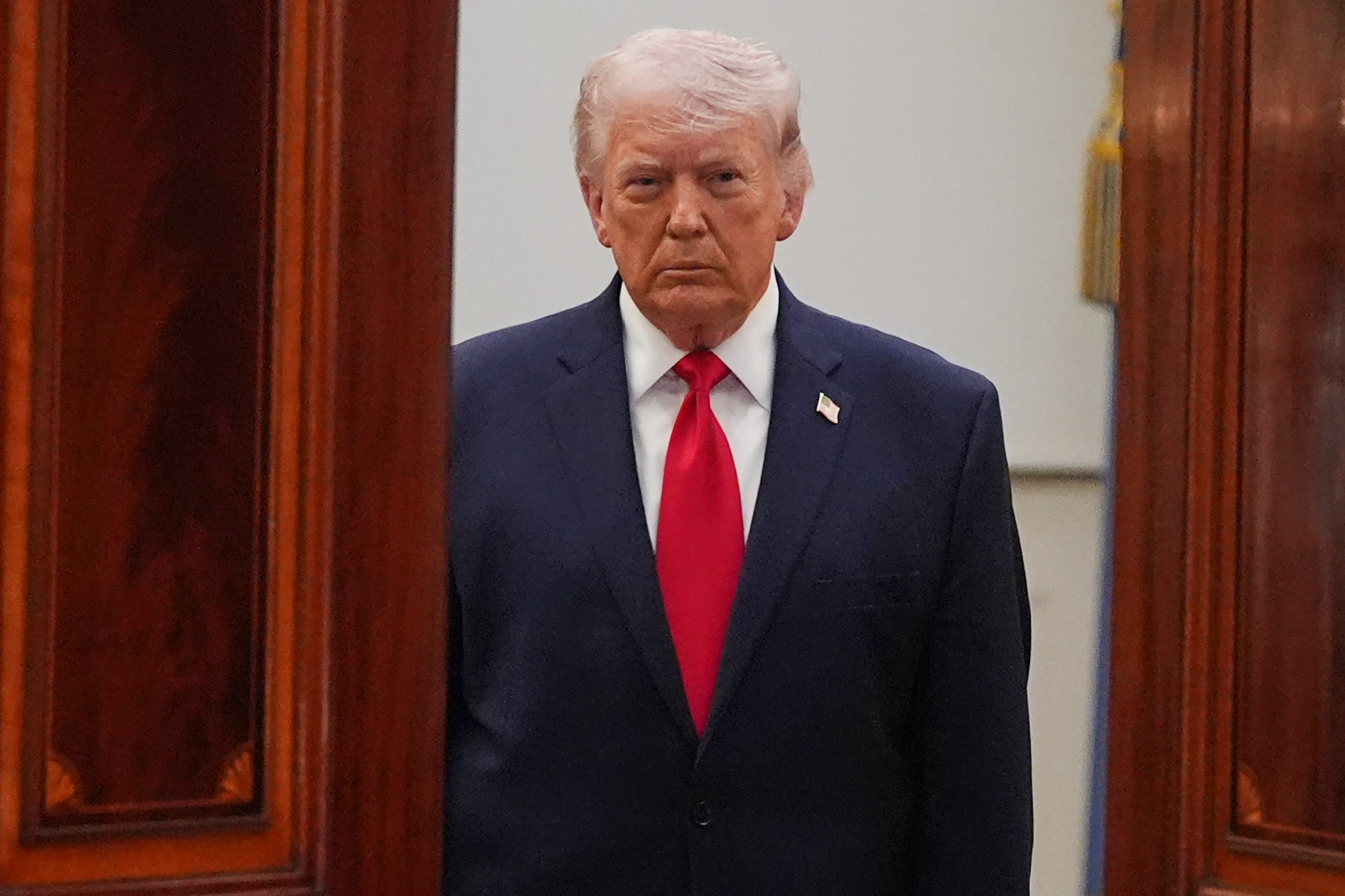
In a national address on the Iran war Wednesday night, President Trump offered no exit plan beyond claiming that US “military objectives”, which have changed as much as his conflicting rationales for starting the conflict, will be achieved “very shortly.” The main objective, he made clear, is to escalate joint US-Israeli bombings of Iran’s civilian infrastructure. “Over the next two to three weeks,” Trump said, “we are going to bring them back to the Stone Ages, where they belong.”
True to his word -- and to Secretary of War Pete Hegseth’s earlier promise of “death and destruction from the sky, all day long,” – the US and Israel followed up with a new round of war crimes. The latest US-Israeli strikes include an under-construction bridge linking Tehran to the western city of Karaj, built to ease traffic for millions; residential buildings; steel factories; pharmaceutical plants; universities; and the storied Pasteur Institute, a century-old center for health research.
After claiming two days earlier that he had made “great progress” in talks with the Iranian leadership, Trump made no mention of it, presumably because such progress, and the talks themselves, are another presidential fiction. He instead reiterated that the bombing spree is aimed at forcing Iran to fully reopen the Strait of Hormuz. Unless Iran relents, he said, the US will destroy “each and every one of their electric generating plants,” which will be hit “very hard.” Welcoming Trump’s threat, Sen. Lindsey Graham summarized it as follows: “You either do a deal where you get out of the business you’re in, or we’re going to blow your stuff up — the things that will allow you to function as a nation. That is your choice.”
By Iran’s impermissible “business”, Graham means possessing the capacity to defend itself and supporting regional allies like Hezbollah and Yemen’s Ansar Allah. This alliance, the Wall Street Journal recently noted in a rare acknowledgment of the war’s actual aims, “serve[s] as the main challenge to U.S. and Israeli dominance in the region.” Destroying schools, pharmaceutical plants, factories, and other “things” that allow Iran to function as a nation all serve the decades-old policy of making civilians suffer if their governments challenge US-Israeli dominance.
Unwilling to surrender to the global hegemon and its nuclear-armed outpost in Tel Aviv, Tehran has responded with the limited leverage it has. Defying Trump’s early claims of military victory, Iran continues to strike US assets in the Gulf, fire missiles at Israel, and selectively block the Strait of Hormuz, the transit point for one-fifth of global oil supplies, to widen the economic pain of Trump’s aggression. Earlier today, Iran downed a US fighter jet for the first time, a stark refutation of Trump and Hegseth’s claims that Iranian air defenses are neutralized. Despite talk of an invasion, the current US force posture does not appear sufficient for a ground war. If Trump indeed has no military solution to reopen the Strait, then it appears that he will settle for destroying as much of Iranian society as he can before the political clock runs out on his war of choice.
While Trump also claimed that “regime change was not our goal,” the opposite is the case. As the New York Times reports, the Israeli Mossad went into the war with plans “to galvanize the Iranian opposition — igniting riots and other acts of rebellion that could even lead to the collapse of Iran’s government.” Instead, hundreds of thousands of Iranians have taken to the streets to defend their country’s sovereignty. As Air Force Gen. Alexus Gregory Grynkewich, the head of the US European Command, recently noted before Congress: “What I’ve observed over the course of studying air power in history is that any time you attack a civilian population, you usually end up finding that it just hardens their resolve.”
Unfortunately for Iran’s civilian population, a mirror dynamic is at work. When a foreign country resists their aggression, the US and Israel are resolved to achieve state collapse for as long as it takes. In Syria, a far smaller and weaker country than Iran, it took 13 years of CIA-backed insurgency; crippling sanctions; and a plundering US military occupation to overthrow Bashar al-Assad’s government. In Iran, the US and Israel are hoping to expedite the process with airstrikes that leave Iran’s economy and institutions in ruins, laying the foundation for social unrest or even a civil war that ultimately ends in regime change.
While Iran’s infrastructure is pulverized, working people in the US and around the world are left to absorb the growing costs of Trump’s wrecking ball. On top of the deprivation from destroyed infrastructure and higher food and energy costs worldwide, Trump is equally indifferent to his own population. Hours before his Iran speech, Trump informed a White House luncheon that it’s “not possible” for the US government to fund Medicare, Medicaid and child care programs: “We can’t take care of day care. We’re a big country. We have 50 states. We have all these other people. We’re fighting wars.” In fact, he’s destroying another society that stands in the way of US-Israeli dominance, just as in Iraq, Libya, Syria, Palestine, Yemen, and Lebanon.
Two days before Trump’s day care complaint, Secretary of State Marco Rubio offered a revealing gripe of his own. “Imagine an Iran that, instead of spending their wealth, billions of dollars, supporting terrorists or weapons, had spent that money helping the people of Iran,” Rubio said. “You’d have a much different country.”
Imagine if Rubio could apply these professed standards to the administration he serves. Moreover, imagine if Trump could merely live up to his own campaign rhetoric since 2015, in which he repeatedly offered an identical critique of the United States. “We’ve spent $4 trillion trying to topple various people,” he said on the 2016 campaign trail, when we could have used that money “to fix our roads, our bridges, and all of the other problems... Imagine if that money had been spent here at home.”
Now presiding over another war of aggression, Trump has just requested a record $1.5 trillion military budget, a roughly 40% increase to be offset by $73 billion in spending cuts on domestic programs. Trump is spending US wealth on immiserating the people of Iran and millions more worldwide, all while shunning the needs of his own citizens. Along with hurting generations of Iranians, he is ushering in a much different, more dangerous world.
Also, big beautiful cuts over 10 years is pretty bad.
Here's one thing that jumped out from Google Gemeni
Office of Civil Rights and Civil Liberties (CRCL): The proposed $37.9 million cut reduces the office from its 2025 level of approximately $43 million down to just $5.1 million.
Staffing Impact: This reduction reportedly slashes the workforce from 135 employees to only four full-time positions.
Yes, Trump. It's impossible to fund Medicare, Medicaid and child care programs. God forbid, you should help US citizens in need. That would be unreasonable. War, on the other hand, there's always plenty of money for needless death and destruction. Tupac Shakur must be turning in his grave.
Thanks, Aaron. Nice profile picture. 👍