

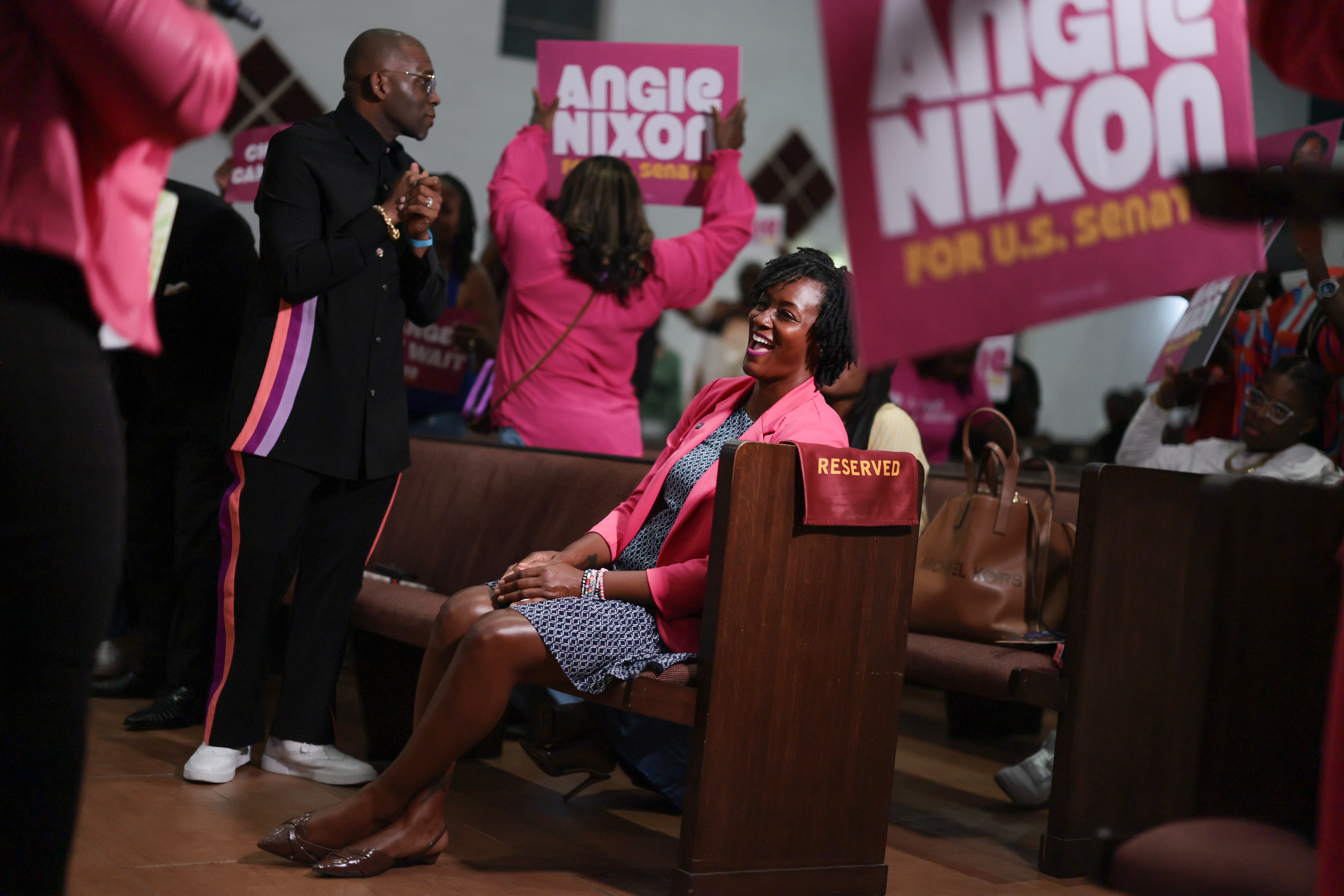
Alexander Vindman, a former National Security Council official who rose to fame as a star witness in Donald Trump’s first impeachment, has become the latest neoconservative candidate to lose a Democratic primary. In a major upset, Vindman was defeated Tuesday by State Representative Angie Nixon, a democratic socialist and Medicare-for-All advocate, in the race for Florida’s Democratic Senate nomination. He lost despite national name recognition and a 16-to-one fundraising advantage. Whereas Vindman spent $2 million on ads, Nixon spent less than $60,000.
Nixon, one of only two state lawmakers to call for a ceasefire in Gaza after Israel began its post-October 7th mass murder spree, ran a spirited grassroots campaign that tapped into her experience as a union organizer. By contrast, Vindman, a staunch supporter of Israel, wrote her off and treated his victory as a foregone conclusion. He refused to debate Nixon and rarely mentioned her by name. According to one veteran political consultant, Vindman “literally laughed at Angie Nixon” and “didn’t even think he was in a primary.” In one of his campaign’s few acknowledgments of his opponent, Vindman’s wife mocked Nixon on social media for failing to wear “professional clothes” — a jab for which she was forced to apologize.
After the recent defeat of Rep. Dan Goldman in New York, Vindman is now the second major figure from Ukrainegate, the scandal behind Trump’s first impeachment, to lose a Democratic primary. Vindman triggered the controversy by reporting concerns about the infamous July 2019 phone call between Trump and Ukrainian president Volodymyr Zelensky. Vindman, who was born in Ukraine, was outraged because Trump had paused a weapons shipment to Kyiv while pressuring its government to assist with his political grievances, primarily getting to the bottom of the effort to frame his presidency as a Russian operation.
Vindman supported the policy of arming Ukraine against Russian-backed rebels in the Donbas rather than using Washington’s post-Maidan leverage to end the fight. The impeachment scandal that he generated cemented this agenda to an unprecedented degree. While Democrats presented their case as a valiant defense of the U.S. democratic process, the underlying message was at stark odds with any such principle. According to Vindman and other impeachment witnesses, American foreign policy was no longer the purview of an elected president, but of unelected bureaucrats. As House Democrats put it, Trump, by freezing the weapons shipment, had acted “against the interests of U.S. national security, and over the objections of these career experts.”
The possibility that an elected president could overrule “career experts” was particularly vexing to star witness Vindman. “I knew the president had clear and straightforward talking points—I’d written them,” he recounted in his memoir of the Trump-Zelensky call. “He was to congratulate Zelensky, show support for Ukraine’s reform and anti-corruption agenda, and urge caution regarding the Russians.” But the insubordinate president, Vindman complained, “wasn’t using my talking points at all.” Ignoring Vindman’s holy writ wasn’t the president’s only transgression. His heretical pause on the Ukraine military package “was baffling. Not only was it a 180-degree turn from the stated policy the entire U.S. government supported, but it was also contrary to U.S. national-security interests in the region.” When it came to “official Ukraine policy,” Vindman added, there was “broad consensus in the diplomatic and military parts of the administration. What exactly, we wondered, was the president doing?”
It did not occur to Vindman and his fawning media cheerleaders, particularly on MSNBC, to ask the inverse question: in deciding that national security mandarins could overrule an elected president, what were they doing? Many Democratic and Republican lawmakers surely shared Vindman’s objections, and his view of Ukraine as “a frontline state and a bulwark against Russian aggression.” Yet under the longstanding norms of U.S. democracy, setting “official Ukraine policy” is the commander-in-chief’s prerogative. The Constitution, it turns out, contains no exception for executive policies that contradict the “broad consensus” of unelected subordinates.
In articles for The Nation at the time, I warned that “the Cold War mindset that liberals have embraced threatens not just their own political fortunes but also global peace.” On the latter front, by cementing a bipartisan consensus to arm Ukraine rather than encourage it to make peace with Russia, Ukrainegate paved the way for Russia’s invasion of February 2022, and all of its catastrophic consequences. When it comes to Democrats’ political fortunes, Trump is now in his second term. Vindman was elevated to Democratic stardom in an era when Cold War dogma was treated as the anti-Trump party line. He has now become the latest establishment stalwart to learn that Democratic voters want to resist the Republican agenda with policies that center humanity, not the bipartisan militarism of “career experts.”
Good riddance. Vindmann was an undecover Ukrainian nationalist who served his "commander in Chief" Trump as an interpreter during confidential conversations with a foreign leader. Regardless of how he felt he had no right to rat on his President because he did not agree with something the President said in a confidential situation. He was rightfully drummed out of the Army for his disloyalty and he is exactly as Maté describes: a neo-con who was taken advantage of by the freakout during the Trump impeachment years led by Little Adam Shitt.
Congratulations to Angie Nixon – proof that money doesn't always guarantee you victory. Excellent work! Thanks, Aaron